

Last Updated: November 4, 2026
Quick Summary
Clean label protein is a protein product made with a short, recognizable ingredient list and no unnecessary additives, fillers, or artificial sweeteners. The term describes how a product is formulated, not how safe it is, and no federal agency defines it, so any brand can print it on a tub.
- Read the ingredient list in order, since ingredients appear by weight and the first item is the biggest part of the scoop.
- Divide protein grams by scoop grams: a 30g scoop delivering 25g of protein is mostly protein.
- Heavy metals come from the ground, not the factory, so a natural or organic label does not protect you.
- Ask for a certificate of analysis and confirm the batch number matches the tub in your hand.
- A not detected result means below the limit of detection, not zero.
Table of Contents
- What Clean Label Protein Actually Means
- How to Read a Protein Powder Ingredient Label
- Protein Powder Additives to Avoid and Why They End Up in the Tub
- Why Heavy Metals Keep Showing Up in Protein Powder
- How to Find the Best Protein Powder Without Heavy Metals
- What Third-Party Tested Protein Powder Really Proves
- What Clean Label Does Not Guarantee
- Pick a Protein That Shows Its Work
- Frequently Asked Questions
What Clean Label Protein Actually Means
Clean label protein is a protein product made with a short, recognizable ingredient list and no unnecessary additives, fillers, or artificial sweeteners. The term describes how a product is formulated, not how safe it is. That distinction matters more than most shoppers realize.
A tub can carry a clean label and still contain contaminants. A tub can list twenty ingredients and pass every safety test. The label tells you what the maker chose to put in. It does not tell you what testing found.
Below, we'll show you exactly how to read a label, spot additives, and check test data before you buy.
Where the Term Comes From and Where It Stops
The phrase started in food marketing, where shoppers pushed back against long lists of unfamiliar ingredients. Supplement brands borrowed it. No federal agency defines "clean label," so any brand can print it on a tub.
That is the catch. "Clean label" is a marketing term, not a regulated claim. It stops at the ingredient panel. It says nothing about heavy metals, banned substances, or label accuracy.
How to Read a Protein Powder Ingredient Label
Start with the ingredient list, not the front of the tub. The front panel sells. The back panel tells you what you are actually buying.
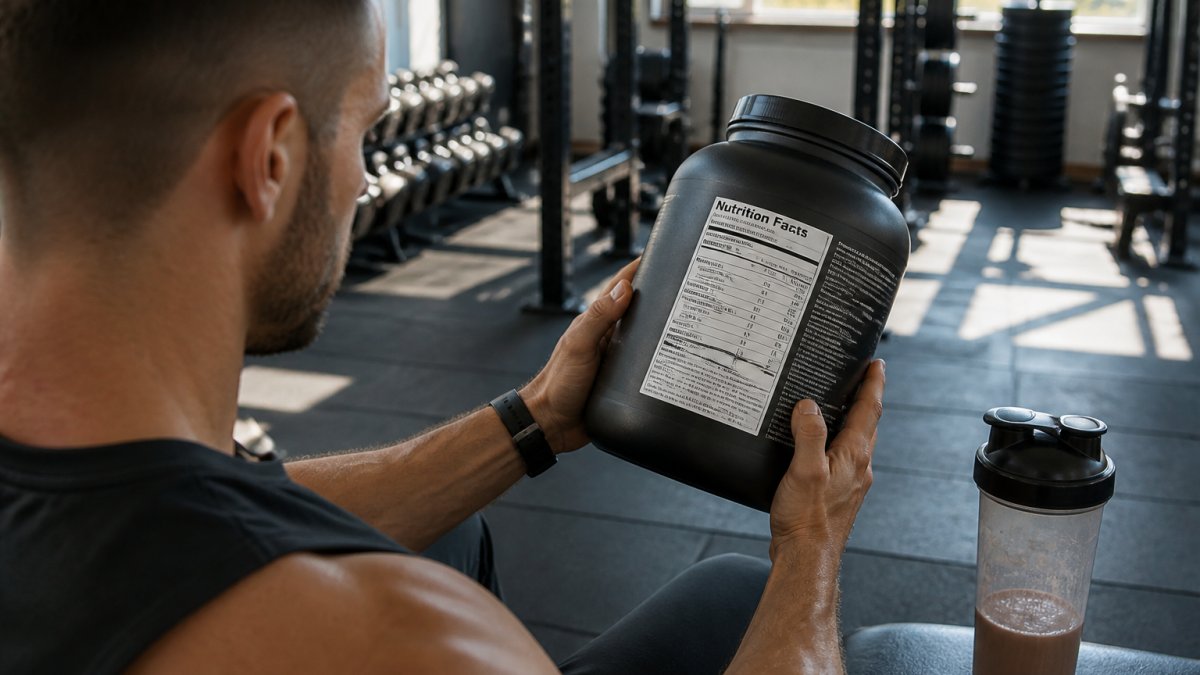
- Count the ingredients. A short list is easier to audit than a long one. A five-ingredient tub gives you five things to verify; a twenty-ingredient tub gives you twenty, and most shoppers stop checking after the first few.
- Find the sweetener. Look for stevia, monk fruit, or sugar. Note any artificial sweeteners such as sucralose or acesulfame potassium. The sweetener's position in the list tells you how much of it you are getting, a sweetener listed second is a large share of the scoop.
- Check protein per serving against scoop size. A 30g scoop delivering 25g of protein is mostly protein. A 40g scoop delivering 20g is mostly filler, flavoring, and thickener. Divide protein grams by scoop grams to see the real ratio.
- Look for a testing claim. A batch number and a certificate of analysis beat a logo. A logo alone tells you a certification exists somewhere; a batch number lets you check the specific tub in your hand.
Watch out: a "proprietary blend" line lets a brand list ingredients without showing amounts, so you cannot tell whether the protein source is the largest ingredient or the smallest.
For a deeper walkthrough on decoding panels and spotting red flags, read our guide on how to read supplement ingredient labels.
Run through these five checks on the back panel before you buy.
| Check | What to look for | Why it matters |
|---|---|---|
| Protein source first | Whey isolate, whey concentrate, or plant blend leads the list | Protein below a sweetener or filler means the scoop is mostly not protein |
| Count the ingredients | A short list is easier to audit than a long one | Five ingredients give you five things to verify |
| Find the sweetener | Stevia, monk fruit, sugar, sucralose, or acesulfame potassium | Position in the list shows how much you are getting |
| Protein per serving vs scoop size | Divide protein grams by scoop grams | A 30g scoop with 25g protein is mostly protein |
| Testing claim | Batch number and certificate of analysis beat a logo | A batch number lets you check the specific tub |
Protein Powder Additives to Avoid and Why They End Up in the Tub
Additives show up for three reasons: they add bulk, they improve texture, and they cut cost. A scoop of protein costs money. Fillers and thickeners do not.
Watch for these:
- Artificial sweeteners like sucralose and acesulfame potassium
- Gums and thickeners such as xanthan and cellulose
- Anti-caking agents like silicon dioxide
- Artificial colors and flavors
- Proprietary blends that hide doses
None of these are illegal. The issue is disclosure. A blend lets a brand list ingredients without showing amounts.
If sweeteners are your main concern, our article on identifying artificial sweeteners in protein powder breaks down what to look for on the panel.
Why Heavy Metals Keep Showing Up in Protein Powder
Heavy metals come from the ground, not the factory. Plants take up lead, cadmium, arsenic, and mercury from soil and water. Cocoa, rice, and some plant proteins concentrate them more than others.
That means a "natural" label does not protect you. A product can be organic and still carry trace metals. The question is whether levels sit below safety limits and whether the brand tests for them.
The FDA's guidance on heavy metals in foods sets the framework regulators use for these limits. For a full breakdown of sources and risk, see our guide on avoiding heavy metals in supplements.
Shift8 Isolate Protein Chocolate 1lb →
How to Find the Best Protein Powder Without Heavy Metals
The best protein powder without heavy metals is one whose maker tests every batch and publishes the results. Testing beats marketing every time.
Here is how we would screen a brand:
- Ask for a certificate of analysis for the batch you are buying.
- Check the lab name. An independent lab carries more weight than an in-house one.
- Look at the detection limits. A test that cannot detect low levels proves little.
- Confirm the batch number matches the tub in your hand.
A brand that publishes results openly is telling you something. A brand that dodges the question is telling you something too.
What Third-Party Tested Protein Powder Really Proves
Third-party tested protein powder has been checked by a lab that does not work for the brand. That is the whole promise. It confirms the batch was tested. It does not confirm the product is flawless.
What most guides miss is the detection limit. If a lab can only detect lead above a certain level, a "not detected" result means "below that line," not "zero." A result of "not detected" against a high detection limit is weaker evidence than a quantified low result against a tight one.
Reading a Certificate of Analysis and Its Detection Limits
A certificate of analysis lists each test, the method, the result, and the limit of detection. Compare the result to the limit, not to zero. Here is how to work through one:
- Match the batch number. The certificate must name the same lot printed on your tub. A certificate for a different batch tells you nothing about what you bought.
- Identify the lab. An independent lab carries more weight than an in-house one. Look for a lab name you can look up, not a generic "third-party tested" badge.
- Read the units. Heavy-metal results are usually reported in parts per million (ppm) or micrograms per gram (µg/g), which are equivalent. A result of 0.05 ppm is 0.05 µg/g, the same number in different clothing.
- Check the limit of detection (LOD) and limit of quantification (LOQ). The LOD is the lowest level the method can reliably see; the LOQ is the lowest level it can reliably measure. A "not detected" result means below the LOD, not zero.
- Convert to your serving. A result is reported per gram of powder. Multiply by the scoop size to see what you actually consume per serving. A small per-gram number can still add up across two or three scoops a day.
- Compare against a reference. The FDA's guidance on heavy metals in foods sets the framework regulators use for these limits. Compare the serving-level exposure to that framework rather than to a competitor's marketing claim.
Watch out: a certificate that reports only "pass" or "fail" without the underlying number and detection limit gives you almost nothing to evaluate. Ask for the full report with results, methods, and limits.
Our guide on how to verify third party supplement testing walks through the exact steps to confirm a brand's claims.
What Clean Label Does Not Guarantee
Clean label does not guarantee safety, purity, or accurate dosing. It describes ingredients, nothing more.
Three things it cannot tell you:
- Contaminant levels. A short list says nothing about heavy metals.
- Label accuracy. The panel can still overstate protein content.
- Sourcing or manufacturing quality. Neither appears on the label.
Treat clean label as a starting filter. Then verify with test data.
Pick a Protein That Shows Its Work
A clean label is a claim. Test data is proof. Ask for both, and walk away from any brand that will only give you one.
Shift8 Labs builds around that idea. Our Isolate Protein Chocolate delivers 25g of protein per serving with just 1g of carbs and 0g added sugar, plus a digestive enzyme blend of protease and papain. Our Salted Caramel Premium Whey Protein brings 24g of protein and 5.1g of BCAAs per serving. No filler, no fluff.
Shop Shift8 Labs and pick a protein that shows its work.
Frequently Asked Questions
Does a clean label mean a protein powder is safer or healthier?
No. A clean label describes what is listed on the ingredient panel, not what was tested for. A short list of recognizable ingredients tells you the formulation is simple, but it says nothing about whether the powder was screened for lead, cadmium, arsenic, or mercury. Those contaminants come from soil and sourcing, so they can appear in a product with a pristine ingredient list. Treat the label as one data point and pair it with independent test results before you decide a product is safe.
How can you tell if a protein powder has been tested for heavy metals?
Look for a specific claim rather than a vague badge. A credible third-party tested protein powder names the lab or program, states which contaminants were screened, and publishes results you can request or download. If a brand says only that it is quality assured, ask for the certificate of analysis for your lot number. A real report lists each element tested, the result, and the detection limit, so you can see how far below the safety threshold the reading sits.
Which additives in protein powder should I actually avoid?
Start with the ones that do not serve your training. Artificial colors and dyes add nothing to recovery. Sugar alcohols and added fibers in large amounts cause digestive discomfort for many people. Proprietary blends hide doses, so you cannot tell how much of each ingredient you get. Non-nutritive sweeteners are a personal call. None of these are automatically dangerous, but each one is a reason a tub costs what it does without helping you rebuild muscle.
Is a longer ingredient list always worse?
Not automatically, but it deserves scrutiny. Some added ingredients earn their place, such as a digestive enzyme blend like protease and papain that helps break down protein. The question is whether each line item does something for you. If you cannot explain why an ingredient is there, that is the signal to look at a simpler formulation instead.
