

Table of Contents
- Why Heavy Metals End Up in Supplements
- What Third-Party Supplement Testing Actually Verifies
- How to Read Supplement Ingredient Labels for Contamination Risk
- COA for Supplements: How to Verify What You're Buying
- Heavy Metal Limits and What the FDA Actually Enforces
- Home Testing Kits and the Limits of DIY Screening
- Conclusion
- Frequently Asked Questions
Last Updated: September 14, 2026
Why Heavy Metals End Up in Supplements
Heavy metals in supplements are trace elements like lead, cadmium, arsenic, and mercury that enter the supply chain through contaminated soil, water, or manufacturing equipment. Avoiding heavy metals in supplements starts with understanding that contamination is usually a raw-material problem, not a final-mix problem. This guide breaks down how contamination happens and how to verify what you're buying.
Plants absorb metals from the ground they grow in. Rice, cocoa, and certain botanicals are especially efficient at pulling cadmium and lead from soil, which is why protein powders built on plant bases carry different risk profiles than whey-based ones. FDA guidance on lead in food and supplements documents how dietary intake accumulates across all food sources, not just capsules.
A common mistake is assuming "natural" means "clean." It doesn't. Soil contamination is a farming reality, and heavy metal poisoning is a cumulative exposure problem, not a single-dose event.
Plant-Based Ingredients and Soil Contamination
Plant-based sources carry higher contamination risk because plants take up metals directly from soil. Rice protein, brown rice flour, and cocoa are three of the most frequently flagged ingredients in third-party testing. This doesn't make plant proteins unsafe by default, but it does mean the brand's sourcing and testing standards matter more.
Whey and other animal-derived proteins tend to test cleaner for cadmium and arsenic, largely because the metals concentrate in the plant matter animals eat rather than the milk they produce. If you rotate between plant and animal proteins, expect different risk profiles from each.
What Third-Party Supplement Testing Actually Verifies
Third-party supplement testing verifies that a product's heavy metal levels fall within established limits and that the label matches the contents. It does not certify a product is "safe" in absolute terms. It confirms a specific batch met a specific standard on a specific date.
The most recognized certifications come from organizations like NSF International and USP, which run independent testing against purity standards and manufacturing practices. NSF International supplement certification program explains that certified products undergo facility audits and ongoing batch testing, not a one-time check.
Batch Testing vs. Single-Lot Testing
Batch testing checks every production run; single-lot testing checks one sample and lets the result stand in for everything else. The difference matters enormously when you're taking a product daily.
| Testing Type | What It Covers | Reliability |
|---|---|---|
| Single-lot | One sample, one date | Low; doesn't reflect other runs |
| Batch testing | Every production lot | High; catches variation between runs |
| Facility audit | Manufacturing practices | Medium; process-level, not product-level |
A brand that publishes a single passing test from two years ago is telling you almost nothing. A brand that tests each batch and publishes results is showing you a pattern.
How to Read Supplement Ingredient Labels for Contamination Risk
How to read supplement ingredient labels comes down to three things: ingredient source, proprietary blends, and certification marks. Labels are legally required to list ingredients, but they are not required to disclose contamination testing. That gap is where risk hides.
Start with the source. "Rice protein concentrate" tells you less than "organic brown rice protein from a named supplier." Vague sourcing makes risk assessment impossible.
Then check for certification seals. A USP or NSF mark on the label means an outside party verified the product. No seal doesn't mean contamination, but it does mean you're trusting the brand's word alone.
A Risk-Tier Framework for Supplement Categories
Most guides tell you to "buy reputable" without explaining which categories carry the most contamination risk. Here is a tiered framework based on how often third-party testing flags each category:
Higher risk, plant-derived and mineral-heavy products:
- Protein powders, especially plant-based (rice, pea, cocoa-flavored). Rice protein and cocoa are among the most frequently flagged ingredients for cadmium and lead because the plants take up metals from soil.
- Herbal and botanical extracts (ashwagandha, turmeric, ginseng, valerian). These concentrate whatever was in the plant, and sourcing varies widely by region.
- Calcium and bone-health supplements, particularly those derived from bone meal, dolomite, or oyster shell, which can carry lead.
- Green powders and superfood blends, which often combine multiple plant ingredients and multiply the sourcing risk.
Moderate risk, animal-derived and fermented products:
- Whey and collagen proteins tend to test cleaner for cadmium and arsenic because metals concentrate in plant matter rather than milk or connective tissue.
- Fish oil and omega-3s carry mercury risk, though molecular distillation removes most of it in quality products.
Lower risk, synthetic and isolated vitamins:
- Synthetic vitamins (ascorbic acid, thiamine, riboflavin, etc.) are chemically synthesized and generally not exposed to soil contamination.
- Isolated amino acids and single-ingredient synthetic compounds carry low heavy metal risk by nature of their production.
This doesn't make plant-based or herbal products unsafe by default. It means the brand's sourcing and testing standards matter more in those categories, and a COA is more important to request.
- Proprietary blends: A single "blend" listing hides individual ingredient amounts. You can't assess dosing or contamination risk per ingredient.
- Certification marks: Look for USP, NSF Certified for Sport, or Informed Sport seals.
- Serving size vs. actual dose: A large scoop doesn't guarantee meaningful dosing of the active ingredient.
The Label Doesn't Tell You What You Need Most
The most important contamination information is not on the label. It's in the COA, the batch testing record, and the supplier documentation, none of which are legally required to appear on the bottle. Treat the label as a starting filter, not a safety guarantee.
COA for Supplements: How to Verify What You're Buying
A COA for supplements is a certificate of analysis: a document from a laboratory showing the test results for a specific batch. It lists what was tested, the method used, the result, and the acceptable limit. Requesting one is the single most direct way to verify a claim.
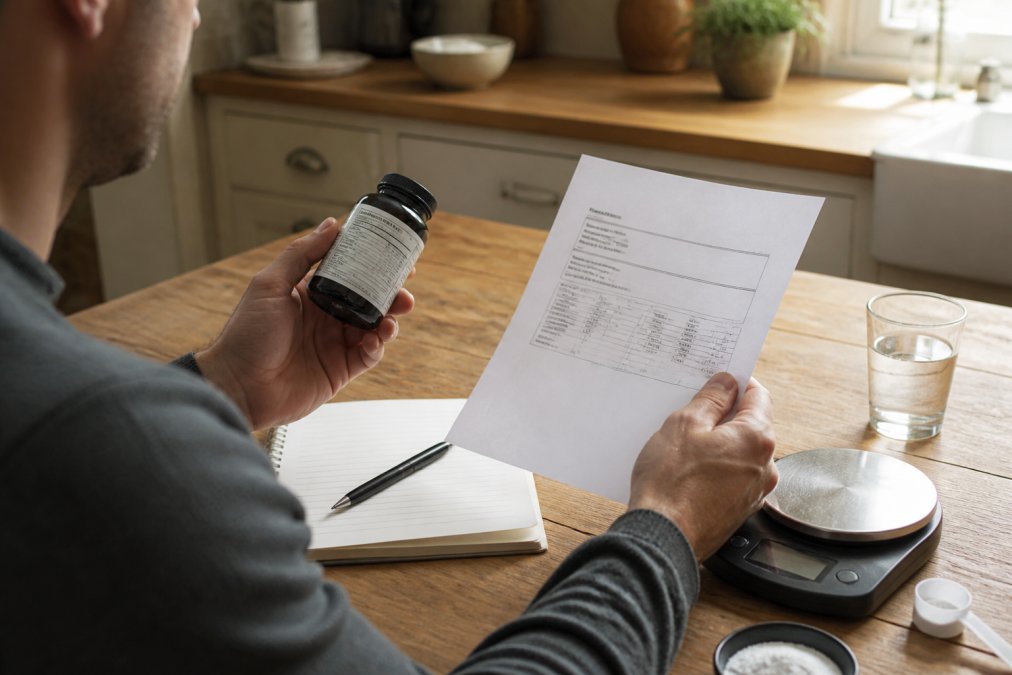
To use a COA properly, match the batch number on your bottle to the batch number on the document. A COA for a different lot tells you nothing about your product. Check that the lab is accredited and independent, not a brand-owned facility.
What most guides miss is that a COA should show a measured value, not just a "pass." "Lead: below limit" is weaker than "Lead: 0.02 ppm, limit 0.5 ppm." The measured number lets you assess risk rather than accept a binary.
Heavy Metal Limits and What the FDA Actually Enforces
Heavy metal limits for supplements are not set as a single federal standard the way they are for some foods. Instead, the FDA regulates through current good manufacturing practices (21 CFR Part 111) and can act against products that are adulterated or misbranded under the Federal Food, Drug, and Cosmetic Act. FDA current good manufacturing practices for dietary supplements outlines the requirements manufacturers must meet, including specifications for identity, purity, strength, and composition.
The practical consequence is that a supplement can legally contain measurable lead or cadmium and still be sold, as long as the manufacturer has established specifications and the product is not deemed adulterated. There is no universal "FDA heavy metal limit" stamped on every bottle.
The Numbers That Actually Apply
Where concrete thresholds exist, they come from a patchwork of sources rather than one federal rule:
- California Proposition 65 sets a Maximum Allowable Dose Level (MADL) for lead of 0.5 micrograms per day, and requires a warning above that. This is why some supplement labels carry a lead warning that has nothing to do with federal rules.
- USP <2232> (Elemental Contaminants in Dietary Supplements) establishes limits by dosage form. For a supplement taken at 1-3 servings per day, the oral daily exposure limits are roughly 2.5 mcg/day for lead, 2.5 mcg/day for cadmium, 1.5 mcg/day for arsenic (inorganic), and 1.5 mcg/day for mercury.
- NSF/ANSI 173 and NSF Certified for Sport apply similar elemental contaminant limits and add banned-substance screening on top.
- Informed Sport and Informed Choice (LGC) test for both heavy metals and prohibited substances, with results published per batch.
State-level requirements can be stricter than federal ones, and they vary. Proposition 65 in particular has driven reformulation across the industry because the warning threshold is low and the litigation risk is high.
Why "Passing" Is a Moving Target
A product can pass one standard and fail another because the limits differ by organization, dosage form, and serving size. A lead result of 1.0 mcg/day might clear a federal adulteration threshold but exceed California's Prop 65 MADL. This is why a COA should always state which standard the result is being compared against, a "pass" without a named limit is unverifiable.
When you evaluate a brand's testing claims, ask three questions: Which standard? Which lab? Which batch? If any of the three is missing, the claim is marketing, not verification.
Home Testing Kits and the Limits of DIY Screening
Home testing kits for supplements exist, but their limits matter more than their convenience. Most consumer kits use a color-change reaction that detects the presence of a metal, not a precise concentration. A positive result tells you something is there; it rarely tells you how much.
That distinction is critical. Heavy metal limits are about concentration over time, and a kit that can't measure parts per million can't tell you whether a product is within a safe range. False negatives are common when concentrations are low.
If you want real verification, a COA from an accredited lab beats a home kit every time. Use home kits as a rough screening tool at most, and never as a substitute for documented batch testing.
A related trap is the detoxification myth: the idea that a "detox" supplement can pull accumulated metals out of your body. There's no credible mechanism for most of these products, and some introduce their own contaminants. Avoidance and verified sourcing do more than any cleanse.
Conclusion
The real challenge with avoiding heavy metals in supplements isn't finding information. It's finding a brand that will show you its testing data instead of asking you to trust a label. Most contamination risk comes from sourcing and manufacturing choices you can't see, which is exactly why verification matters more than marketing.
At Shift8 Labs, we build clean formulations with purposeful dosing and no filler, designed for athletes who want to know what's actually in the bottle. Our minimalist approach means fewer ingredients to trace and fewer places for contamination to hide.
If you're serious about what you put in your body, consider Shift8 Labs and train with supplements built on transparency, not claims.
Frequently Asked Questions
How can I tell if my supplements have been tested for heavy metals?
Look for a certificate of analysis (COA) tied to the specific batch number printed on your bottle. Reputable brands publish COAs from third-party labs showing results for lead, cadmium, arsenic, and mercury. If a brand only says 'third-party tested' without a downloadable COA or batch lookup, you cannot verify the claim. Check the testing lab's name too. Results from an accredited independent lab carry more weight than an in-house test.
Which heavy metals are most commonly found in supplements?
Lead, cadmium, arsenic, and mercury appear most often in contaminated products. These metals occur naturally in soil and water, so plant-based ingredients like rice protein, cocoa, and some herbal extracts can absorb them during growth. A 2024 Consumer Reports review of protein powders found measurable lead in several products. The risk depends on dose and frequency, which is why batch testing and heavy metal limits matter more than a single lab result.
What does the FDA regulate regarding heavy metals in dietary supplements?
Under the Dietary Supplement Health and Education Act (DSHEA), the FDA treats supplements as food, not drugs. The agency sets no universal heavy metal limit for supplements the way it does for bottled water. Instead, manufacturers must follow current Good Manufacturing Practices (cGMP) and ensure products are not adulterated. The FDA can act after contamination is found, but it does not pre-approve products or test every batch before sale.
Are detoxes or cleanses effective for flushing heavy metals from the body?
Most commercial detox products have no evidence they remove heavy metals. The body clears small amounts through the liver, kidneys, and sweat, but clinical chelation therapy for genuine heavy metal poisoning uses prescription drugs under medical supervision. Those drugs carry real risks, including kidney damage and mineral depletion. The better approach is avoiding heavy metals in supplements in the first place by choosing brands that publish third-party testing results and COAs.