

Table of Contents
- Step 1: Check the Certification Seal and Verify Its Authenticity
- Step 2: Look Up the Product in Certification Databases
- Step 3: How to Read a Supplement Certificate of Analysis
- Step 4: Understand What Independent Testing Actually Screens For
- Step 5: Know the Limits of FDA Regulation for Dietary Supplements
- Common Mistakes When Verifying Supplement Testing
- Conclusion
- Frequently Asked Questions
Last Updated: September 15, 2026
Step 1: Check the Certification Seal and Verify Its Authenticity
Verifying third party supplement testing starts with the seal on the bottle. A certification seal is a mark from an independent organization confirming a product passed testing for purity, potency, and contaminants. It is not a government approval, nor a brand's own quality claim.
Here's the problem most athletes miss: anyone can print a seal graphic on a label. The seal only carries weight if you confirm the certifying body actually tested that product. Legitimate programs publish searchable listings, and the seal should name the certifier clearly, not use a vague "lab tested" badge.
At Shift8 Labs, third-party verification is a baseline, not a marketing extra.
How to Spot Fake Supplement Certifications
Fake certifications share recognizable red flags:
- A seal with no certifying organization named
- A logo that mimics a real program but changes the wording slightly
- No lot number or product listing anywhere on the package
- A "certified" claim that appears only in marketing copy, never on the label
- A QR code that leads to the brand's own homepage instead of a certifier's database
The fix: write down the certifier's name, then check its official website. If the organization doesn't exist or doesn't list the product, the seal is decoration.
Step 2: Look Up the Product in Certification Databases
The fastest way to confirm a claim is a database lookup. Most major certifiers maintain public, searchable product directories: enter the brand or product name, and the listing confirms whether that specific item is certified.
Here's the practical workflow:
- Identify the certifying organization from the seal.
- Go directly to that organization's official website by typing the address yourself.
- Find the "certified products" or "find a product" search tool.
- Search by brand name, then confirm the exact product and lot.
- Verify the certification is current, not expired.
Typing the address yourself matters: fake seals sometimes include QR codes routing to lookalike sites designed to confirm a certification that doesn't exist.
What a Real Database Listing Actually Shows You
A legitimate listing includes the brand, the specific product, the certification program, and, for batch-level programs, a lot or batch identifier, plus certification and expiration dates.
When you open a listing, check three things:
- Exact product match. "Whey Protein" is not the same as "Whey Protein Isolate" or a different flavor or size. Certifications are product-specific.
- Lot or batch match. For batch-level programs, the listing should reference the same lot number printed on your bottle. A listing for a different lot does not verify your bottle.
- Current status. Certifications lapse. A listing that shows an expired date is not proof of anything today.
If the listing only shows a brand name with no product or lot detail, treat it as a marketing claim, not a verification.
NSF vs USP vs Informed Choice Certification: Which Database to Search
Three programs dominate sports and dietary supplement certification, and each verifies something different.
| Program | What It Verifies | Best Known For | Where to Search |
|---|---|---|---|
| NSF Certified for Sport | Contaminants, banned substances, label accuracy | Athletes subject to drug testing | NSF official product directory |
| USP Verified | Ingredient identity, potency, purity, manufacturing | Broad dietary supplement quality | USP verified products list |
| Informed Choice | Banned substances, batch-level screening | Everyday sport and fitness users | Informed Choice product search |
A quick way to remember the difference: NSF Certified for Sport and Informed Choice focus on what athletes can't have in their system, while USP Verified focuses on whether the label matches the bottle.
How to Spot a Counterfeit or Photoshopped Seal
Most guides tell you to look for a seal, but almost none explain how to tell a real one from a fake. Check these:
- Resolution and edges. A seal that has been pasted onto a label image often has jagged edges, a slightly different background color, or a shadow that doesn't match the rest of the label.
- Font consistency. Counterfeit seals frequently use a near-miss font or slightly altered wording ("NSF Sport Certified" instead of "NSF Certified for Sport").
- Missing program identifiers. Real seals usually include a program name, a trademark symbol, or a registration number. Fakes often drop these.
- QR destination. Scan the QR code and read the URL before you tap it. A real certifier's QR goes to the certifier's domain, not the brand's homepage or a shortened link.
- Reverse image search. If the same seal image appears on dozens of unrelated brands, it is almost certainly a stock graphic, not a certification.
If any of these flags appear, go to the certifier's site directly and search the product yourself.
Step 3: How to Read a Supplement Certificate of Analysis
A certificate of analysis (COA) is a document from a testing lab reporting results for a specific batch. It is the most detailed proof you can get, and where serious buyers separate real transparency from marketing.
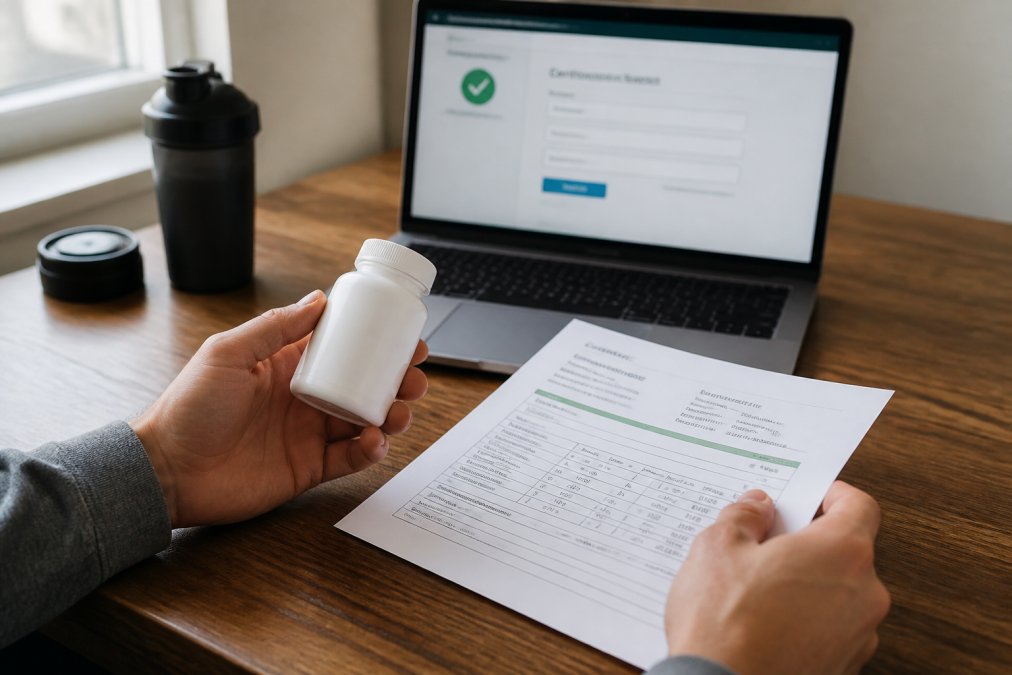
A useful COA includes several core elements:
- Lot number matching your bottle
- Test date and the lab's name
- Ingredient identity confirming the raw material is what the label claims
- Potency results showing the actual amount of each active ingredient
- Contaminant screening for heavy metals, microbes, and residual solvents
- Pass/fail or numeric results for each test
Who Issues a COA, and Why It Matters
A COA should come from an analytical laboratory, not the brand's marketing department.
How to Tell a Real COA from a Fabricated One
Fabricated or recycled COAs share recognizable traits:
- No lot number, or a lot number that doesn't match your bottle. This is the single most common giveaway.
- No lab letterhead, signature, or report number. Real lab reports are traceable documents.
- Identical results across every batch. Real testing produces variation. If every COA a brand posts shows the exact same numbers, they are likely copied.
- Missing units. Potency should be reported in specific units (mg, mcg, IU, CFU) with a measured value, not just a checkmark.
- No method reference. Real reports name the test method (for example, ICP-MS for heavy metals or HPLC for potency).
- Dates that don't line up. A test date before the batch was manufactured, or a COA dated years ago for a product still being sold, is a problem.
Matching Lot Numbers and Batch Testing to Your Bottle
The lot number ties a COA to your specific product.
What a COA Does Not Tell You
Step 4: Understand What Independent Testing Actually Screens For
Independent testing checks for the things that hurt athletes most.
Step 5: Know the Limits of FDA Regulation for Dietary Supplements
The FDA regulates dietary supplements as a category of food, not drugs.
Common Mistakes When Verifying Supplement Testing
For athletes who want to skip the guesswork, this is where brand choice matters. Shift8 Labs builds clean formulations with purposeful dosing and no filler, the kind of product designed to hold up under the scrutiny this guide describes. You can review the FDA's supplement fact sheet for the regulatory basics, then hold every brand to the same standard.
Conclusion
Verifying supplement testing takes effort, and regulation alone won't confirm what's in your bottle.
Frequently Asked Questions
How do I check if a supplement brand is third-party tested?
Start by looking for a certification seal from a recognized program like NSF Certified for Sport, USP Verified, or Informed Choice on the label. Then go to that organization's website and search the product name or brand. If the product appears in their database, the certification is real. If it doesn't, the seal may be fake or expired. You can also request a certificate of analysis directly from the brand and check that the lot number matches your bottle.
What is the best website for third-party supplement testing verification?
The three main databases are NSF's certified product listing, USP's verified products directory, and Informed Choice's certified product search. Each covers different certification programs. NSF and USP focus on manufacturing standards and label accuracy, while Informed Choice specializes in banned substance screening for athletes. Search all three if you want full coverage, since a product may hold one certification but not the others.
Do the FDA regulate dietary supplements for purity and potency?
The FDA regulates dietary supplements as a category of food, not as drugs. That means products don't need FDA approval before they're sold. The FDA can take action after a product hits the market if it's unsafe or mislabeled, but it doesn't verify label claims or test every batch for potency. This is exactly why independent certification and third-party testing matter. They fill the gap the FDA leaves open.
How can I tell if a supplement certification seal is fake?
Fake seals usually have small errors: wrong colors, blurry logos, misspelled organization names, or a design that doesn't match the official version. The fastest way to confirm is to go directly to the certifying body's website and search for the product. Legitimate certifications are always listed in a public database. If the product isn't there, or if the brand can't provide a certificate of analysis with a matching lot number, treat the seal as unverified.