

Last Updated: November 1, 2026
Quick Summary
Most adults should take 3 to 5 grams of creatine monohydrate daily, and this creatine dose is the maintenance amount backed by decades of research. Take one serving a day, every day, including rest days. Loading is optional at about 20 grams per day split into four 5-gram doses for 5 to 7 days.
- Three grams per day is a solid floor for smaller adults or lighter training loads.
- A loading phase uses about 20 grams daily in four 5-gram doses for 5 to 7 days.
- One level scoop per day suits most people, but scoops vary by brand so check the label.
- Take creatine on rest days too, since saturation depends on daily intake, not training days.
- Vegetarians and vegans can reasonably target the top of the range at 5 grams per day.
Table of Contents
- How Much Creatine Should You Take Per Day?
- Creatine Loading Phase Dosage: How It Works and Who Needs It
- Creatine Without Loading: The Steady Approach
- How Many Scoops of Creatine Per Day?
- Taking Creatine on Rest Days: Do You Still Need It?
- Personalizing Your Dose by Body Weight, Diet, and Training
- Safety, Side Effects, and When to Talk to a Clinician
- Choosing a Creatine You Can Dose With Confidence
- Frequently Asked Questions
How Much Creatine Should You Take Per Day?
If you want the short answer: most adults should take 3 to 5 grams of creatine monohydrate every day. That's the dose backed by decades of research.
The confusion comes from wildly different numbers online. Some sources push 20 grams a day; others say 2 grams is plenty.
Below, we'll cover the exact numbers, how to measure them, and how to adjust your creatine dose for your body and training.
The Standard Daily Dose: 3 to 5 Grams
Three to five grams per day is the maintenance dose for healthy adults. Take it consistently, and your muscle creatine stores stay topped off.
Here's the practical breakdown:
- 3 grams per day: a solid floor for smaller adults or lighter training loads
- 5 grams per day: the most common target, and the amount in a standard serving
- Higher doses: only useful during a loading phase, which we cover next
You don't need to split this into multiple doses. One serving a day does the job.
Why Creatine Monohydrate Is the Standard Form
Creatine monohydrate is the most studied form of creatine, and it's the one nearly all dosing research is based on.
That matters for dosing. When a study says "5 grams per day," it means monohydrate. Buy a different form and you're guessing at equivalence.
A common mistake is chasing fancy versions before nailing the basics. For help picking a clean, well-tested monohydrate, see how to choose clean creatine monohydrate.
Here is the daily dosing at a glance.
| Item | Value | Note |
|---|---|---|
| Standard daily dose | 3 to 5 grams | Maintenance dose for healthy adults |
| Lower end | 3 grams per day | Floor for smaller adults or lighter training |
| Common target | 5 grams per day | Amount in a standard serving |
| Doses per day | One serving | No need to split |
| Loading phase | About 20 grams per day | Four 5-gram doses for 5 to 7 days |
| Loading math | About 0.3 g/kg per day | Split across the day |
| Maintenance math | Roughly 0.03 g/kg per day | Round up to the 3 g floor |
| Standard scoop | About 5 grams | Check the label; scoops vary by brand |
Creatine Loading Phase Dosage: How It Works and Who Needs It
A loading phase uses a higher dose to saturate your muscles fast.
After that, drop to the 3-to-5-gram maintenance dose. Loading reaches full saturation in about a week instead of several weeks.
Who actually needs it? Competitive athletes with a meet or event coming up. Everyone else can skip it. The end result is the same, just slower.
Watch out: splitting 20 grams into four doses across the day matters. Taking it all at once tends to upset your stomach. Spreading doses every few hours keeps it tolerable.
Creatine Without Loading: The Steady Approach
You can skip loading entirely and still reach full muscle saturation. Take 3 to 5 grams daily, and your stores climb steadily over a few weeks.
This is the approach we recommend for most people: simpler, easier on the gut, and it avoids the bloating some feel during loading.
The catch is patience. You won't feel the full effect for a few weeks. But once you're saturated, the daily dose keeps you there.
How Many Scoops of Creatine Per Day?
One level scoop per day is the answer for most people. A standard creatine scoop holds about 5 grams, which matches the maintenance dose.
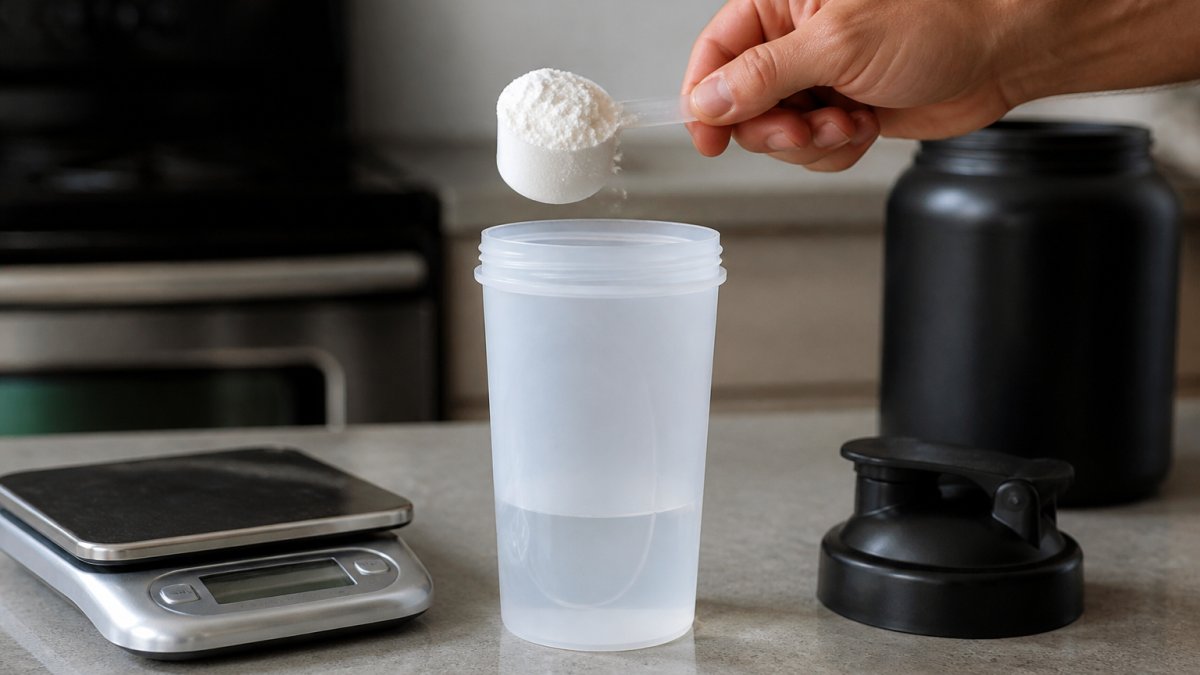
But scoops vary by brand, so check the label. Some use a smaller scoop that holds only 3 grams; others pack a heaping scoop closer to 7 grams.
Here's how to measure accurately:
- Use the scoop that comes with your product, and level it off with a knife
- Check the serving size on the supplement label for the gram amount
- Weigh it once on a kitchen scale to confirm your scoop matches the label
Mixing is the other half of the equation. If you want a powder that dissolves fully, read about creatine powder that dissolves completely.
Taking Creatine on Rest Days: Do You Still Need It?
Yes. Take creatine on rest days too. Your muscles don't stop holding creatine just because you skipped the gym.
The goal is saturation, which depends on daily intake, not training days. Skipping rest days slows you down and breaks your consistency.
Timing barely matters, with a meal, in the morning, or after a workout. What counts is that you take it every day.
Personalizing Your Dose by Body Weight, Diet, and Training
Body weight is the biggest lever on your creatine dose, but most people don't need a calculator. The standard 3-to-5-gram maintenance range covers the vast majority of healthy adults. Body-weight math matters mainly when you're loading, well outside the average size range, or want a defensible number instead of a round one.
The body-weight math, in plain terms
Research protocols typically express dosing in grams per kilogram of body weight. A common loading approach is about 0.3 g/kg per day, split across the day, for 5 to 7 days (Creatine supplementation). Maintenance then drops to roughly 0.03 g/kg per day.
Here's what that looks like at real body weights (1 kg = 2.2 lb):
- 130 lb (about 59 kg): loading ≈ 18 g/day; maintenance ≈ 1.8 g/day, so round up to the 3 g floor
- 160 lb (about 73 kg): loading ≈ 22 g/day; maintenance ≈ 2.2 g/day, so 3 g is sufficient
- 185 lb (about 84 kg): loading ≈ 25 g/day; maintenance ≈ 2.5 g/day, so 3 to 5 g
Two takeaways. First, the 3-to-5-gram maintenance range already absorbs most body-weight variation, which is why it's the default. Second, if you're loading, the 20-gram-per-day protocol is a reasonable approximation for many adults, but heavier athletes may benefit from spreading a slightly larger total across four doses.
When body-weight dosing is worth the effort
A personalized gram target is most useful in four situations:
- You're loading for an event. The 0.3 g/kg figure gives a defensible total instead of guessing whether 20 grams is enough.
- You're a larger athlete. At 220 lb and up, 5 grams is fine for maintenance, but loading at a flat 20 grams may undershoot the protocol.
- You're small or new to training. A 3-gram floor is plenty; there's no benefit to forcing 5 grams if 3 sits better.
- You're tracking response. Weighing your dose once confirms your scoop matches the label, which matters more than a precise gram target.
Diet: meat eaters versus vegetarians
Creatine is found naturally in red meat and fish, roughly 1 to 2 grams per pound of raw meat, though cooking degrades some of it. That background intake matters at the margins:
- Regular meat eaters start with partially loaded muscles, so 3 grams per day is often enough to maintain saturation.
- Vegetarians and vegans typically have lower baseline muscle creatine, so they may notice a larger response and can reasonably target the top of the range at 5 grams per day.
- High training volume increases turnover slightly, nudging you toward 5 grams, but it does not justify going above the standard range outside a loading phase.
Population-specific guidance
The standard dose is studied mostly in healthy adults, so other groups need a more careful approach:
- Older adults (roughly 60+): creatine is commonly studied for muscle and strength support in this group, and 3 to 5 grams per day is the typical maintenance range. Some research uses higher loading doses, but a clinician should weigh in if you have kidney concerns or take multiple medications.
- Adolescents: there is less long-term safety data for people under 18. Many practitioners advise against routine creatine use in this group, or recommend it only under supervision for specific athletic goals.
- Pregnancy and nursing: creatine has not been established as safe in these populations, so consult a clinician before starting.
A simple decision rule
If you want a framework rather than a formula:
- Default: 5 grams of creatine monohydrate per day, every day.
- Smaller adult or lower training load: 3 grams per day is a fine floor.
- Loading for an event: about 0.3 g/kg per day split into four doses for 5 to 7 days, then back to maintenance.
Safety, Side Effects, and When to Talk to a Clinician
Creatine monohydrate is one of the more widely studied sports supplements, and many healthy adults tolerate standard doses well. A few practical points separate a smooth experience from a confusing one.
Common side effects and what causes them
- Mild stomach upset or loose stools. This is the most common complaint, and it's almost always a dose-size issue. Taking 20 grams at once is far more likely to cause it than spreading four 5-gram doses across the day. If maintenance gives you trouble, take it with a meal.
- Bloating or a few pounds of scale weight. Creatine pulls water into muscle cells, so early weight gain is usually intracellular water, not fat. It typically stabilizes within a couple of weeks.
- No effect on hydration at normal doses. Standard 3-to-5-gram dosing does not meaningfully dehydrate you, but drinking enough water is still sensible, especially in heat or during heavy training.
The creatinine lab-test issue
This is the safety point most guides skip. Taking creatine can raise your creatinine reading even when your kidneys work normally, looking like a false alarm on a routine panel (pubmed.ncbi.nlm.nih.gov).
If you take creatine and your clinician orders kidney labs, tell them you supplement. They can account for it, use a different filtration marker such as cystatin C, or note the baseline.
Who should consult a clinician first
Creatine is well studied in healthy adults, but individualized advice is warranted if you fall into any of these groups:
- Kidney disease or a history of kidney problems. Creatine is not considered harmful to healthy kidneys, but existing disease changes the risk-benefit picture and lab monitoring.
- Liver disease. Less studied in this group, so a clinician should weigh in.
- Pregnancy or nursing. Safety has not been established, so avoid routine use unless a clinician advises otherwise.
What to actually tell your clinician
Keep it short and specific: the form (creatine monohydrate), the dose (for example, 5 grams per day), how long you've taken it, and whether you've loaded. That's enough for them to interpret labs and flag anything relevant.
What the evidence does and doesn't support
At standard doses, creatine monohydrate is not linked to kidney damage in healthy people, and concerns about liver harm or dehydration at normal doses aren't supported by the research. Higher-dose claims, including loading protocols, are supported for saturation speed but not for additional long-term benefit beyond maintenance.
If you have a medical condition, take prescription medications, or are pregnant or nursing, talk to a clinician before starting. It's just good sense.
Choosing a Creatine You Can Dose With Confidence
A dose is only as good as the product behind it. If the label says 5 grams, you want to trust you're getting 5 grams of creatine and nothing else.
Look for three things:
- Pure creatine monohydrate, with no fillers
- Third-party testing you can actually verify, see how to verify third party supplement testing
- A clear serving size so your scoop matches the dose
At Shift8 Labs, we build clean, intentional formulations with purposeful dosing and no fillers.
Frequently Asked Questions
Do I need to load creatine, or can I take the same amount every day?
You can skip loading. A daily creatine dose of 3 to 5 grams will saturate your muscles over roughly 3 to 4 weeks, while a loading phase of about 20 grams per day split into four doses reaches the same point in 5 to 7 days. Loading is optional and only worth it if you want results fast. Most people do fine starting at the standard daily dose and staying consistent.
Is 20 grams of creatine a day too much?
Twenty grams per day is a standard loading dose, not a long-term habit. It is typically split into four 5-gram servings taken every few hours over 5 to 7 days. After that, drop to a maintenance dose of 3 to 5 grams daily. Higher single doses can cause bloating or stomach upset, so spreading them out matters. Anyone with kidney concerns should check with a clinician before using higher doses.
Should I take creatine on rest days?
Yes. Creatine works by keeping your muscle creatine stores saturated, and that saturation fades if you skip days. Take your usual 3 to 5 grams on rest days, ideally around the same time you would on training days. Consistency matters more than timing, so pick a slot you will not forget, like with breakfast or your morning shake.
How long does creatine take to work without loading?
Without a loading phase, expect muscle creatine stores to reach saturation in about 3 to 4 weeks of daily 3 to 5 gram dosing. Performance benefits build as saturation rises, so early weeks may feel modest. With a loading protocol, saturation happens in 5 to 7 days. Either way, daily consistency is the variable that decides how quickly you get there.
Getting your creatine dose right comes down to one habit: 3 to 5 grams, every single day, rest days included. The hard part isn't the number. It's finding a product clean enough that you trust every scoop. Shift8 Labs makes that easy with pure micronized creatine monohydrate, no fillers, and a serving that hits the standard dose exactly. Get started with Shift8 Labs and give your training the consistency it deserves.
