

Table of Contents
- Why Intentional Supplement Dosing Matters
- Supplement Dosing and Interactions: What You Need to Know
- How to Choose Dietary Supplements That Fit Your Goals
- Reading Supplement Label Ingredients and Dosage
- Building a Minimalist Supplement Stack
- Tracking and Adjusting Your Dosage Over Time
- Common Mistakes That Undermine Supplement Effectiveness
- Frequently Asked Questions
Last Updated: October 5, 2026
Why Intentional Supplement Dosing Matters
Intentional supplement dosing means choosing specific nutrient amounts based on your individual needs, goals, and health status, rather than taking whatever dose appears on a bottle. More isn't always better: too much of certain nutrients creates problems, and too little wastes money and effort.
Supplement Dosing and Interactions: What You Need to Know
Supplement interactions happen when one nutrient affects how your body processes another, or how a supplement interacts with medication you're already taking. This is where intentional dosing becomes critical.
Some interactions are minor; others reduce effectiveness or cause side effects.
Here's what matters most:
- Check medication interactions first. If you take any prescription drugs, consult a healthcare professional before adding supplements. Many supplements interact with common medications.
- Understand nutrient timing. Some supplements absorb better with food. Others need to be taken on an empty stomach. Spacing matters too, taking certain minerals together reduces absorption for both.
- Watch cumulative intake. If you eat fortified foods and take supplements, you might exceed upper intake levels without realizing it. This applies especially to fat-soluble vitamins that your body stores.
The safest approach: start with one supplement at a time, track how you feel, and add another only after establishing a baseline.
How to Choose Dietary Supplements That Fit Your Goals
Choosing the right dietary supplements starts with honesty about what you actually need, a step most people skip in favor of marketing or a gym buddy's recommendation. Ask yourself:
- What's your actual nutrient gap? Are you deficient in a specific area, or are you trying to optimize performance? These require different approaches.
- What does your current diet provide? If you eat protein-rich foods daily, adding more protein powder might not move the needle. If you rarely eat fatty fish, omega-3 supplementation makes sense.
- What's your training goal? Muscle growth, endurance, recovery, or general health? Different goals support different supplement choices.
Once you've answered these, look for supplements that match your specific need. This is where intentional supplement dosing differs from the typical approach: you're not buying "a pre-workout" because it's popular, but one with specific ingredients at specific doses that align with your training intensity and experience level.
Quality matters too: read the label, look for third-party testing, and avoid proprietary blends that hide ingredient amounts. You can't dose intentionally if you don't know what you're getting.
Reading Supplement Label Ingredients and Dosage
The supplement label is where your intentional dosing strategy lives or dies. It's the only place you can confirm what you're taking, in what amount, and against what safety ceiling.
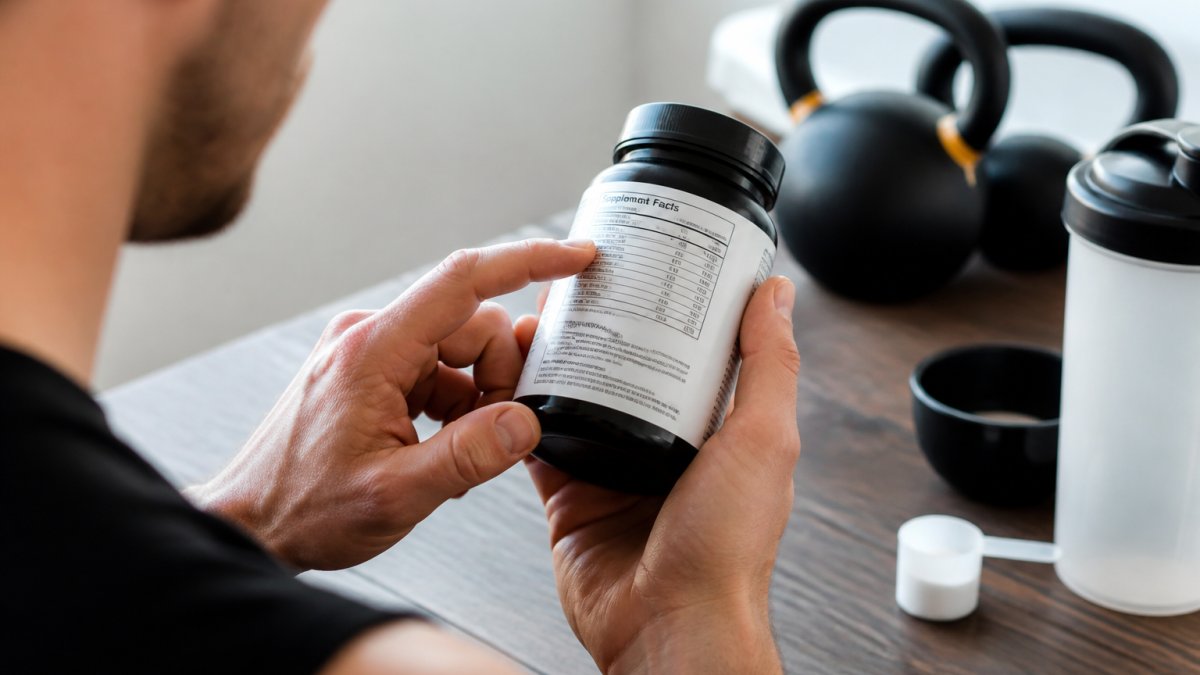
Here's what to actually look for, in order:
- Serving size and servings per container. A label that says "2 capsules" per serving but sells 60 capsules gives you 30 servings, not 60.
- Active ingredients listed by amount. If you see "proprietary blend" instead of specific milligram amounts, move on. You can't dose intentionally without knowing exact quantities.
- Upper intake levels for each nutrient. Some ingredients have established tolerable upper intake levels (ULs) set by the Institute of Medicine (now the National Academies) (Read "Dietary Reference Intakes for Water, Potassium, Sodium, Chloride, and Sulfate" at...). Exceeding them creates risk with no additional benefit.
The label math most people skip
Intentional dosing means converting what the label says into what you actually swallow, then comparing that to a reference intake:
- Vitamin D: Labels often list 25 mcg (1,000 IU) or 50 mcg (2,000 IU) per softgel. The UL for adults is 100 mcg (4,000 IU) per day from all sources. Two 50 mcg softgels put you at the ceiling before you count fortified milk or cereal.
- Vitamin A: Listed as mcg RAE (retinol activity equivalents), not IU. The adult UL is 3,000 mcg RAE per day. Many multivitamins already supply 700-900 mcg RAE, so a separate vitamin A product can push you over.
- Iron: The UL for adults is 45 mg per day. A single "high-potency" iron tablet can be 65 mg, which exceeds the UL on its own. Iron is one of the nutrients where intentional dosing matters most, because excess accumulates.
- Zinc: The UL is 40 mg per day. Common cold-season lozenges deliver 10-25 mg per lozenge, and people often take several per day on top of a multivitamin.
Reading for what's not on the label
The ingredient list matters as much as the amounts. Fillers and unnecessary additives complicate your ability to track what's working, which is why minimalist formulations exist: when you know exactly what's in your supplement and why, you can adjust dosage with confidence.
Two label habits separate intentional dosers from everyone else:
- Check the "other ingredients" line for hidden actives. Magnesium stearate and silicon dioxide are inert. Caffeine, green tea extract, and yohimbine are not, and they sometimes appear in blends marketed as something else.
- Compare the label to the form. Folic acid, methylfolate, and folinic acid are all "folate" but behave differently. Magnesium oxide, citrate, glycinate, and threonate are all "magnesium" but have different absorption and tolerability. The label should tell you the form, not just the nutrient.
Shift8 Labs formulations list every ingredient with exact amounts because that's what serious athletes need. No proprietary blends. No guessing. You know what you're taking and at what dose.

NIH Office of Dietary Supplements fact sheets for nutrient-specific upper limits
Building a Minimalist Supplement Stack
A minimalist supplement stack is the opposite of the typical approach.
Start with the essentials for your specific goal:
- For muscle growth: protein, creatine, and basic recovery support
- For endurance: electrolytes, carbohydrates, and hydration support
- For general health: a quality multi-nutrient base if your diet is inconsistent
- For recovery: amino acids or protein depending on your training intensity
That's it. Everything else is optional until you've optimized these fundamentals.
When you add supplements later, add them one at a time. Wait at least two weeks before adding another.
Shift8 Labs Creatine is a perfect example of intentional minimalism. Five grams of micronized creatine monohydrate per serving. Nothing else.
Tracking and Adjusting Your Dosage Over Time
Intentional supplement dosing requires tracking. Without it, you're just hoping something works.
Build a dose log that actually tells you something
A useful log has six columns: date, supplement, dose, time taken, context (with food, fasted, pre-training), and outcome. The outcome column is where most people fail, because "felt fine" is not data. Record these instead:
- Subjective markers: energy on a 1-5 scale, sleep quality, mood, appetite, GI comfort, joint feel.
- Performance markers: reps at a given weight, pace at a given heart rate, session RPE, time to fall asleep.
- Adherence: did you actually take it, or did you skip? A supplement that works but gets skipped 40% of the time is not working.
- Adverse events: headache, flushing, nausea, insomnia, jitteriness, changes in bowel habits. Note the time between dose and symptom.
A paper notebook or notes app works; the format matters less than the consistency.
Run each supplement as a trial, not a habit
Treat every new supplement like a short experiment with a defined start and end:
- Baseline (week 0): Record how you feel and perform for 3-7 days before starting. Without a baseline, you have nothing to compare against.
- Trial (weeks 1-4): Take the supplement at a fixed dose. Change nothing else. If you add two supplements at once, you learn nothing about either.
- Review (week 4): Compare the trial weeks to baseline. Did the markers you care about move? Did any adverse events appear?
- Decision: Keep, adjust, or stop. Write it down so you don't relitigate it in three months.
Titration: how to adjust without guessing
Titration means changing one variable at a time, in small steps, with a reason:
- Start low. For most nutrients, begin at or below the label's recommended dose, especially if you're also getting the nutrient from food or a multivitamin.
- Hold for at least two weeks before changing anything. Many effects, positive and negative, take that long to surface.
- Adjust by one step. If you tolerate the dose and see no effect, a modest increase is reasonable. If you see side effects, reduce or stop.
- Never stack adjustments. Don't increase dose and add a new supplement in the same week. You won't know which change did what.
Stopping rules: when to pause or call a professional
Intentional dosing includes knowing when to stop. Pause the supplement and consult a healthcare professional if you notice:
- Persistent GI symptoms, rash, or flushing that doesn't resolve within a few days.
- New or worsening insomnia, anxiety, or heart palpitations, especially with stimulant-containing products.
- Any sign of toxicity for the nutrient in question. For fat-soluble vitamins (A, D, E, K) and minerals like iron and selenium, excess accumulates, and symptoms can be subtle at first.
- A new prescription medication. Interactions can change the risk profile of a supplement you've taken safely for years.
Lab markers worth tracking
For some nutrients, how you feel is a poor proxy for status. Blood work is the more honest signal:
- Vitamin D: 25-hydroxyvitamin D is the standard marker. Ask your clinician what target range is appropriate for you.
- Vitamin B12: Serum B12, and sometimes methylmalonic acid, are used to assess status, particularly for people on plant-based diets or metformin.
- Iron: Ferritin, plus a full iron panel, is the standard way to check status. Iron is not a nutrient to dose by feel.
- Lipids and liver enzymes: Relevant if you're using high-dose niacin, certain herbal products, or anything with a hepatic warning.
Many people take a supplement for two weeks, see no immediate change, and assume it doesn't work. But some supplements take time: creatine, for example, builds up over weeks. Tracking reveals this; guessing doesn't.
The data you collect becomes your personal reference, telling you whether to increase, decrease, maintain, or stop each supplement. That's real intentional dosing.
Common Mistakes That Undermine Supplement Effectiveness
Most supplement failures aren't about the product. They're about how people use them.
Mistake 1: Taking too much too fast. High doses don't produce faster results, just side effects.
Mistake 2: Inconsistent dosing. Supplements work through consistency.
Mistake 4: Stacking without research. Adding supplements randomly creates interactions you didn't anticipate.
Mistake 5: Never reassessing. Your needs change as your training progresses.
Intentional supplement dosing transforms how you approach nutrition and training.
This is where Shift8 Labs comes in. Our BCAA + EAA Powder provides complete amino support with transparent dosing.

Frequently Asked Questions
What are the benefits of taking supplements at intentional doses?
Intentional dosing ensures you receive therapeutic amounts of nutrients without excess that could cause toxicity or waste. When you match your dose to your actual nutrient gap, based on diet, age, and health status, you maximize absorption and effectiveness. For athletes, this means better recovery and performance; for others, it means supporting immune function, energy levels, and mental acuity without unnecessary fillers or overdosing on nutrients your body already has.
Can taking too many supplements cause side effects or interactions?
Yes. High doses of fat-soluble vitamins like vitamin E and beta-carotene can accumulate in body tissues and cause toxicity. Mineral overdoses, excess zinc, selenium, or calcium, can trigger nausea, kidney damage, or interfere with other nutrient absorption. Supplement interactions with medications are common: some can reduce drug effectiveness, others increase side effects. This is why reading labels for upper intake levels and consulting your healthcare provider about your full supplement regimen is essential before you start or change doses.
Should I take supplements every day?
Consistency matters for most supplements to build therapeutic levels in your body. Water-soluble vitamins (C, B-complex) need daily intake since your body doesn't store them; fat-soluble vitamins (A, D, E, K) can be taken less frequently because they accumulate. Minerals like calcium and magnesium work best with daily dosing. However, some people cycle supplements seasonally (vitamin D in winter, for example) or adjust based on outcome measurement. Always follow the label directions and discuss your routine with a healthcare professional to confirm daily use is right for your situation.